Misunderstanding Physician Attrition
Yes some doctors are leaving the bedside. That's not a catastrophe. It might even be good.

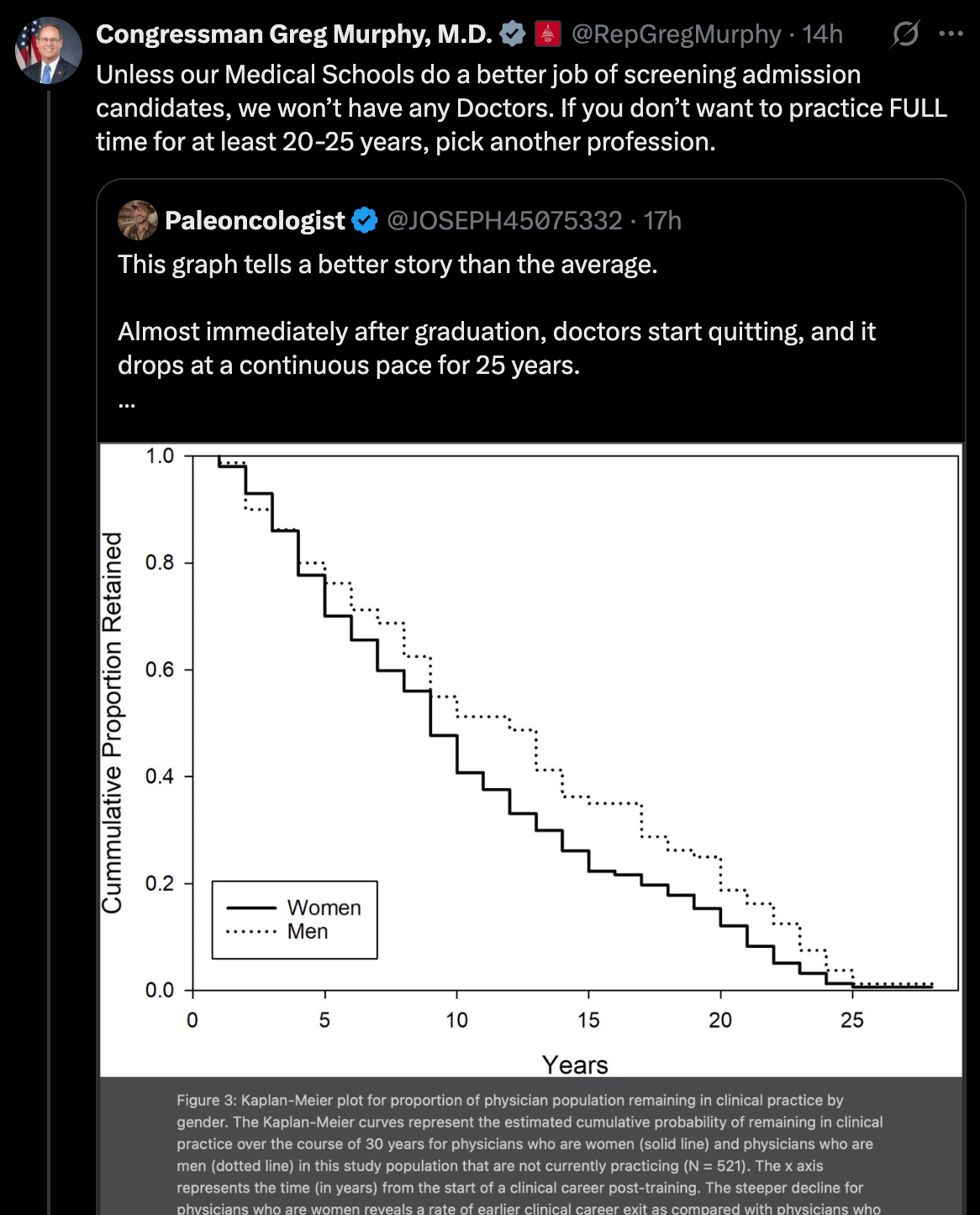
This week, social media lit up with alarm. Politicians, prominent physicians, and health policy commentators posted breathlessly about a crisis: doctors are abandoning medicine in droves. The evidence? Two new papers on physician attrition from clinical practice.
Clearly, none of these commentators bothered to read the Methods.
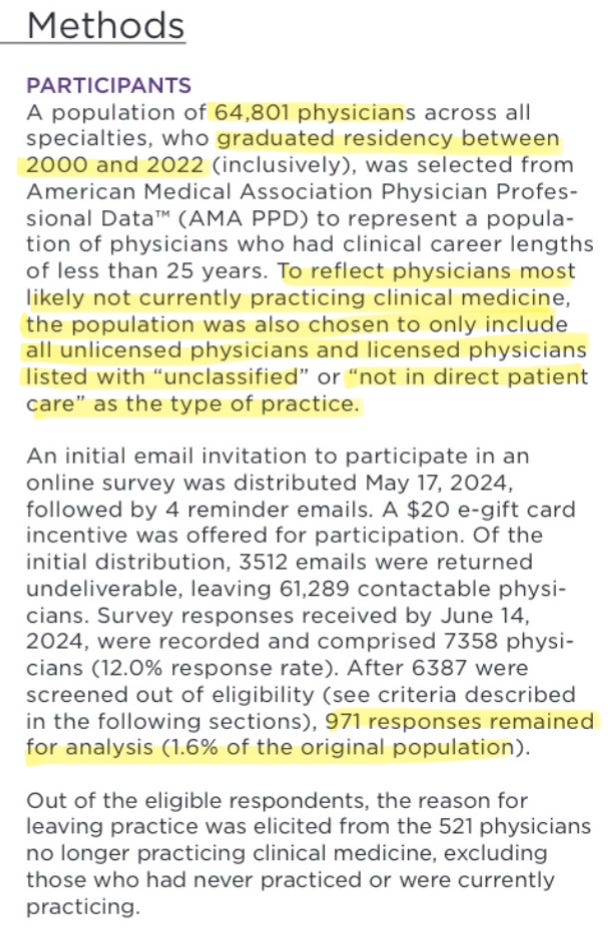
Both papers examined physicians who had already left clinical practice and described their characteristics: a portrait of departures, not a prophecy of collapse. And yet a single Kaplan-Meier plot generated some truly spectacular misreadings. Among the more memorable: that “half of all doctors quit within 10 years,” or that no one is “still work[ing] in clinical medicine within 25 years.” These are not at all what the data show.
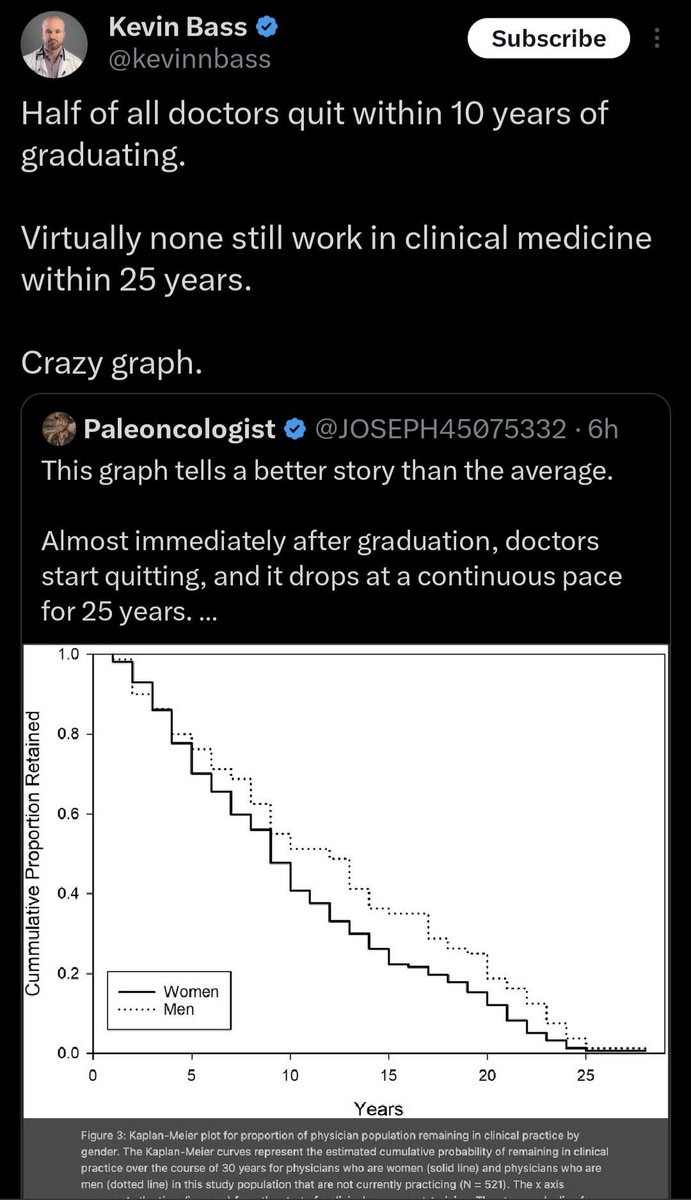
So what does the data actually say?
The papers describe approximately 5% annual attrition from clinical medicine. Let’s put that number in context before deciding whether to panic.
Across professional jobs broadly, annual turnover runs 10–18%. Among registered nurses, the workforce physicians are constantly compared to, it’s around 16%. In the tech industry, you’re looking at 15–20%. Five percent is not a crisis. Five percent is, if anything, surprisingly low for any knowledge profession in the modern economy.
More importantly, attrition from clinical medicine should not be zero:
It is entirely normal and healthy for physicians to move from clinical practice into leadership, research, and medical education roles. Healthcare systems need physician executives, clinical trialists, and department chairs.
It is equally normal for physicians to move into biopharma and tech, industries that desperately need people who understand how drugs work and how prescribers think. How can we hope to develop AI solutions to make physician jobs better without physicians driving tech development? (I know something about this because I’ve spent years doing exactly this...)
Some physicians leave clinical practice to write. Anton Chekhov was a practicing physician. So were Arthur Conan Doyle, Michael Crichton, Siddhartha Mukherjee, and Oliver Sacks. We do not typically describe their career arcs as a workforce tragedy.
Physicians also go into public health, government, and, as at least one of the more hysterical posters about this data has done, into politics. If anything, we need more physicians in government advocating for sensible health policies.
Then there’s retirement. Physicians aged 65 and older currently make up 20% of the clinical workforce, with another 22% are between 55 and 64. A substantial share of annual departures simply reflect people reaching the end of long careers. It is also normal - and morally appropriate - for physicians to leave clinical practice to care for young children or aging parents. We should not build a workforce model that treats caregiving as a leak to be plugged.
Finally, some people leave because clinical medicine isn’t right for them, and that’s okay too. It’s a shame to watch someone exit after the enormous investment of medical school and residency. It is a bigger shame to watch someone stay in a job that makes them miserable because they feel bound by sunk costs. One of the great things about clinical training is it can be used in non-clinical contexts.
Five percent is fine.
But is everything fine?
No. Physician attrition from clinical practice has increased over the past decade, and not all of the increase is benign. Some of it reflects genuine growth in legitimate alternative opportunities: biopharma and med tech are booming, and the workforce is aging. But some of it reflects burnout, and the data here are harder to dismiss.
Physician burnout hit a peak of 53% in 2022, spiking to a record 62.8% during the COVID-19 pandemic. The good news is that it has been declining since: 41.9% of physicians reported at least one burnout symptom in 2025, down from 43.2% in 2024 and 48.2% in 2023. The bad news is that it is uneven. Some specialties (emergency medicine, urological surgery, and hematology/oncology) are all approaching or exceeding 50% burnout rates, meaning nearly half of physicians in some of the highest-demand specialties are running on fumes.
And burnout isn’t just a wellness metric, it translates directly into departures. A 2024 MGMA survey found that 27% of medical groups had a physician leave or retire early that year due to burnout. Physicians working with incompletely staffed teams were more than twice as likely to report burnout, and understaffing itself predicts intent to cut hours or leave entirely, creating a vicious cycle as departures beget departures.
The cost of burnout-driven departures is estimated at $4 billion annually in the United States.
Perhaps most telling is how the reasons for leaving have shifted. The study with the misunderstood Kaplan-Meyer plot found that early departures in 2008 were more likely to be driven by personal health issues, malpractice insurance premiums, and lack of professional satisfaction. The updated data show a shift toward burnout, chronic workplace stress, administrative burden, and unrealistic patient expectations. Burnout and the resulting departures are less about individual circumstances and more about systemic conditions.
That’s the story worth telling. Not “doctors are quitting at rates comparable to baristas and therefore civilization is ending,” but “a measurable and growing fraction of physician departures are burnout-driven, the conditions driving burnout are structural and identifiable, and we know what they are: administrative burden, understaffing, flat reimbursement, and the erosion of professional autonomy.”
The misread Kaplan-Meier curve doesn’t help us understand any of that. If anything, the panic it generated crowds out the more important conversation with noise.
Be difficult. don't compromise. don't be ignorable. fight for yourself and fight for your patient. you can't fix a terminal system by following the rules. if they come for your job, look them in the eye knowing they're firing the only professional in the building who actually knows how to save a life
✊